The 3 BHK vs 4 BHK question usually gets answered with a square-footage comparison and a price difference. Those two numbers matter, but they don’t actually answer the question a family is asking, which is closer to: will this space work for how we actually live, three to ten years from now.
The short version: the right configuration depends more on three specific factors than on raw size — whether you need a dedicated work-from-home room that isn’t also a guest room, whether parents or long-term guests will stay regularly, and your resale or rental time horizon. 3 BHKs typically draw a larger buyer and tenant pool at resale; a 4 BHK suits families who value the extra dedicated room more than that liquidity.
Why “which is bigger” is the wrong question
A 4 BHK is, definitionally, bigger than a 3 BHK in the same project. That’s not in dispute and doesn’t need a framework to establish. What the size comparison alone doesn’t answer is whether the extra room and cost translate into something your household will actually use consistently, or whether it becomes underused space you’re paying to heat, cool, and maintain. That’s a household-specific question, not a universal one — which is exactly why generic “bigger is better” content doesn’t serve buyers well here.
Three questions that actually decide it
Do you need a dedicated work-from-home room?
Post-2020 hybrid and remote work patterns have made a genuinely separate work room — not a corner of the living room, not a room that doubles as a guest bedroom whenever someone visits — a real, recurring need for many dual-income households. If both adults in the household need to be on video calls simultaneously with any regularity, a 3 BHK with a shared “flex” room forces a choice; a 4 BHK removes it. If work-from-home is occasional rather than daily, this factor matters less.
Will parents or long-term guests stay regularly?
There’s a meaningful difference between hosting guests for a weekend and having a parent or in-law stay for extended periods multiple times a year. The latter is closer to a genuine need for a fourth room with real privacy (a door, not just a curtain) than a nice-to-have. If this describes your family’s pattern over the next several years, weight this factor heavily; if visits are occasional and short, a well-designed 3 BHK with a flexible room often covers it.
What’s your resale or rental time horizon?
3 BHK units generally draw a broader buyer and tenant pool — they fit the largest segment of dual-income families and are typically viewed as the “default” premium configuration in a given price band, which tends to mean faster resale and more consistent rental demand. 4 BHKs draw a smaller, more specific buyer pool (larger families, or buyers explicitly prioritising space over liquidity), which can mean a longer resale timeline even when the eventual price achieved is fair. If you expect to hold for a shorter, more uncertain period, this liquidity difference is worth weighing seriously; if you’re buying for the long term with no near-term resale plan, it matters less.
What 3 BHK vs 4 BHK looks like at TRU Aquapolis specifically
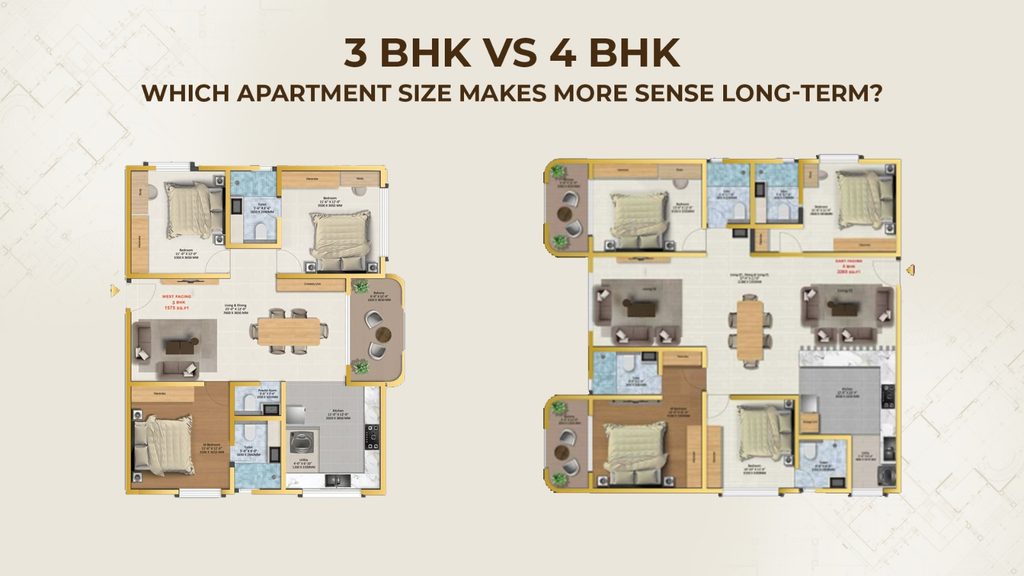
At TRU Aquapolis, 3 BHK units start from 1,575 sq ft, and 4 BHK units go up to 2,590 sq ft — a meaningful difference in usable space, not a marginal one. Applying the framework above: a 3 BHK at this size comfortably supports one dedicated work-from-home room alongside the standard bedroom count for most dual-income households; a 4 BHK adds genuine flexibility for a regular parent-in-residence arrangement or a second dedicated work room, at a price and resale-liquidity trade-off worth weighing against how often that extra room will actually be used. (Confirm current floor plan specifics and pricing for each configuration directly — Floor Plans — since exact unit-wise figures can vary by tower and floor.)
A decision table
| Your situation | Configuration that likely fits better |
| Both adults need simultaneous video-call privacy regularly | 4 BHK, or a 3 BHK with a genuinely separable flex room |
| Parents/in-laws stay for extended periods multiple times a year | 4 BHK |
| Occasional guests, no regular need for a fourth private room | 3 BHK |
| Shorter or uncertain hold period, resale liquidity matters | 3BHK |
| Long-term hold, space valued over liquidity | 4BHK |
| Budget is the binding constraint | 3 BHK, reassessed against the actual cost difference for your specific unit choice |
Frequently Asked Questions
Is a 4 BHK worth the extra cost over a 3 BHK?
It depends on whether the extra room addresses a recurring, specific need (dedicated work space, regular extended-family stays) versus occasional use. If the need is recurring, the extra cost is generally justified for households that can afford it; if it’s occasional, a well-planned 3 BHK often serves the same purpose more efficiently.
Does a 3 BHK resell faster than a 4 BHK?
Generally, yes — 3 BHKs draw a broader buyer and tenant pool in most premium segments, which tends to mean faster resale and more consistent rental demand, though this varies by specific project and market conditions.
How much space does a family of four actually need?
This depends heavily on lifestyle rather than a fixed number — a family that needs a dedicated work room and regular guest accommodation has different space needs than one that doesn’t, even at the same headcount. The three-question framework above is a more useful starting point than a generic square-footage rule.
Is a study/WFH room worth prioritising over a larger living room?
If remote or hybrid work is a regular, recurring pattern for your household, generally yes — a dedicated work room addresses a daily need, while extra living-room space addresses a more occasional one.
The honest bottom line
There’s no universally correct answer between a 3 BHK and 4 BHK — there’s a correct answer for your specific household’s recurring needs and time horizon. Working through the three questions above, rather than starting from square footage, gets to that answer faster
Explore floor plans and schedule a visit — Floor Plans · Pricing Details · Schedule a Site Visit